Research note
Investing in the Trust Layer
The Lupine Science correction-and-verification layer as investable climate infrastructure

Computational materials discovery is no longer short on imagination. Structure generators such as Google DeepMind’s GNoME have proposed 2.2 million candidate crystals[1]; universal machine-learned interatomic potentials (uMLIPs) such as CHGNet and MACE evaluate them at roughly 10⁻⁴ seconds per atom-step; and autonomous labs such as the A-Lab at Lawrence Berkeley National Laboratory attempt synthesis around the clock. The scarce resource is no longer the ability to invent or simulate. It is the ability to believe the result.

Belief is scarce because the pipeline is lossy. GNoME reported 380,000 computed-stable structures, yet only 736 had been independently synthesized by late 2023 — a 0.2% validation rate[1:1]. The A-Lab Author Correction (Nature 650:E1, 2026) records 36 confirmed of 57 eligible targets, with 4 inconclusive and one compound removed for training-data leakage; a separate independent review disputed the novelty classification of many targets[2]. These are not failures of ambition. They are structural symptoms of a field that generates faster than it verifies.
For climate materials, the cost of that asymmetry is measured in gigatonnes and years. Batteries alone are directly linked to roughly 20% of the CO₂ reductions required by 2030 and indirectly to another 40%[3]. Each false positive sends a team into weeks of wasted synthesis; each false negative buries a candidate that might have reached a cell test. Speed without accuracy wastes experiments; accuracy without speed misses the deployment window. The winning infrastructure is the layer that de-risks the lab queue.

The correction-and-verification layer closes that gap.
The layered pipeline, and where it leaks
Computational discovery can be drawn as four stages: generation, prediction, synthesis, and validation. Each stage has dominant platforms; each produces errors that propagate downstream.
At the generation stage, GNoME and recent generators such as Microsoft’s MatterGen produce candidate structures at machine speed. MatterGen reports improved generative-design metrics for inorganic materials, but its outputs are limited to modest unit-cell sizes and do not treat disorder or compositional complexity[4]. GNoME’s 2.2 million predictions excluded polymers, glasses, metal-organic frameworks, heterostructures, and composites — the very material classes most relevant to climate technology[1:2].
At the prediction stage, uMLIPs supply near-DFT energies for the generated structures. They are accurate on bulk properties but systematically soften the potential energy surface away from equilibrium. Across multiple uMLIPs and materials, defect-family observables — surfaces, vacancies, stacking faults — err 15–60× worse than bulk observables[5]. The error is not random: it is a smooth function of local atomic environment, concentrated where coordination deviates from the bulk.

At the synthesis stage, A-Lab and manual labs attempt to make what upstream recommended. Without a characterization of each candidate’s failure modes, the queue is filtered by intuition and compute budget rather than by proof. The corrected A-Lab record is 36 confirmed of 57 eligible targets, with 4 inconclusive and one compound removed; independent novelty critiques are a separate question. High activity is not the same as validated throughput.
The correction-and-verification layer does not compete with any of these layers. It sits between prediction and synthesis: it measures the systematic error of the predictor, corrects it at runtime, and proves which claims can be trusted. The value proposition is partnership, not displacement. MatterGen and GNoME generate more candidates as they improve; the market grows because every additional candidate must be checked.
Three pillars of defensibility
The trust layer is defensible only if it is simultaneously accurate, provable, and deployable. The architecture rests on three pillars that are individually difficult and, to current knowledge, collectively unique in materials science.
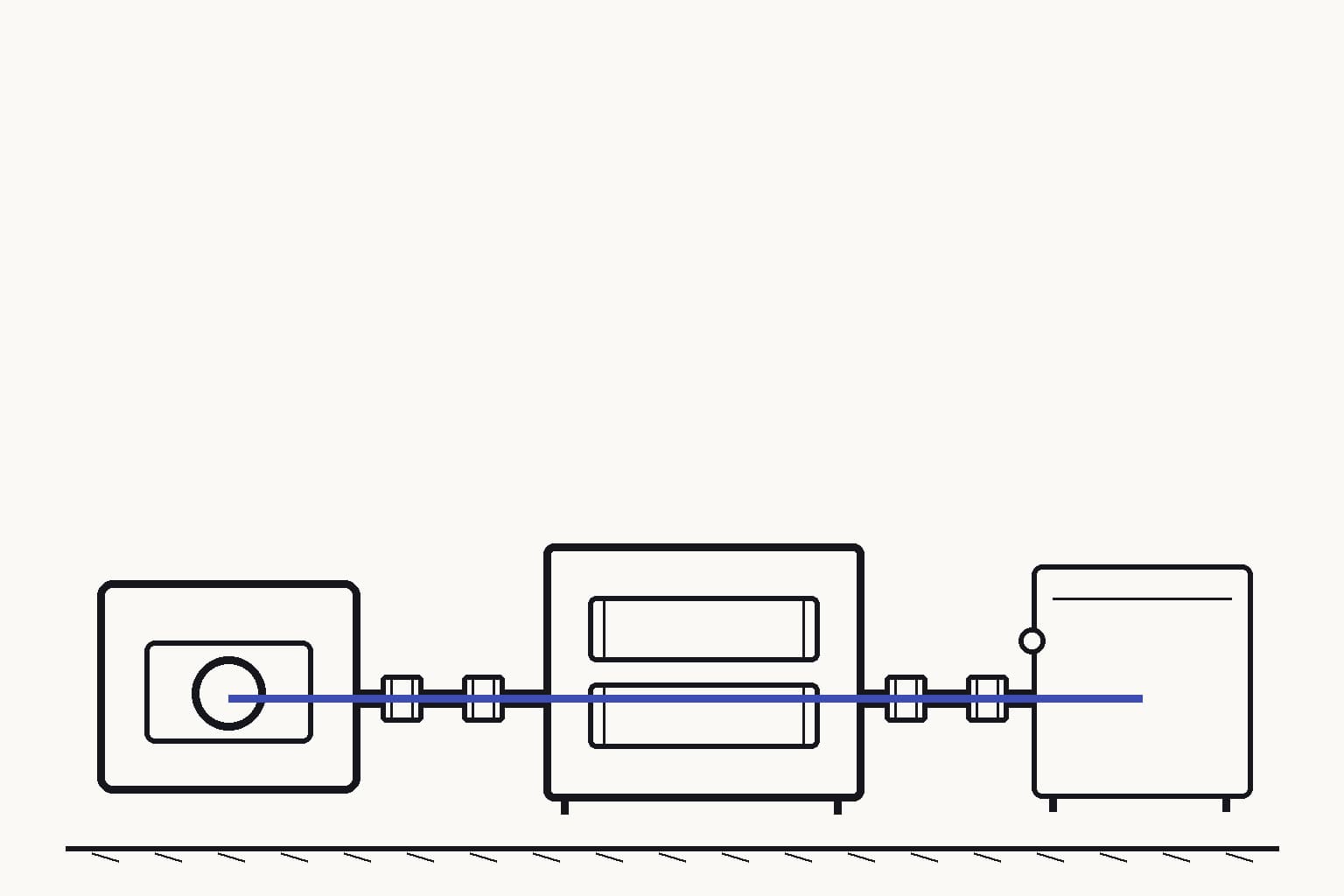

Measured error field, not learned. Rather than training a delta-ML model to fit discrepancies per system, the method treats the uMLIP error as a physical field over local atomic environments. For face-centered-cubic metals, the field is a cubic spline over first-shell coordination number, fixed by three anchor observables — γ₁₀₀, γ₁₁₁, and the vacancy formation energy — with the bulk value constrained to zero at coordination 12. A fourth observable, γ₁₁₀, is held back as a blind test. Across 36 independent (model, material) combinations, the field predicts the never-fitted γ₁₁₀ error with Pearson r = 0.906 (material-clustered 95% CI [0.82, 0.96], p = 10⁻⁴) and zero adjustable parameters.
The distinction from delta-ML and fine-tuning matters commercially. Delta-ML requires retraining for every new material, negating the speed advantage of universal potentials[6]. Fine-tuning requires curated target-system data that does not exist for unexplored composition spaces. The correction is measured from three standard observables and transfers within a structure family; no per-system training is required. The improvement is concrete: on the Ni(110) blind facet, relative error falls from 9.7% to 1.5%; on Cu(110), from 28.0% to 13.7%.
Machine-checked proof. The quantitative claims are sealed as Lean 4 theorems over integer-scaled data carrying SHA-256 provenance. The formalization currently comprises 899 build-locked theorems and zero sorry proofs — Lean’s escape hatch for unproven claims. The count is generated from the Lean source rather than transcribed into this article. The theorems cover ordering inequalities, isotonic correction bounds, and impossibility results where no monotone correction can recover the reference ranking.
This is a categorical difference from statistical validation. Google DeepMind and Microsoft can scale compute indefinitely, but they cannot produce machine-checked proofs of why a prediction should be believed. The Lean kernel once rejected a claim that had survived statistical filtering, reducing a reported success count from 27/36 to 26/36 at integer precision. That episode is the approach in miniature: a trust layer must be able to say no to itself.

Runtime compatibility. The correction term is shaped like an EAM embedding function — a sum over atoms of a function of local coordination — so it deploys as a LAMMPS overlay pair style beside a live CHGNet or MACE calculator. Measured wall-time overhead in Python is 15.6%; a compiled C/C++ or CUDA implementation is expected to drop this below 1%. Even at 15.6%, corrected uMLIPs remain many orders of magnitude faster than DFT for structurally complex cells. Users keep their existing simulators; the trust layer corrects them without retraining.
Why the moat deepens with use
Unlike data-scale moats that erode as competitors scrape the same training corpora, the trust layer’s position strengthens with each screening campaign. Every measured error field adds to a reference database of systematic biases organized by (model, material, structure family). Each impossibility proof sharpens the boundary of applicability. Each experimental validation tightens the feedback loop between computation and synthesis.
Transfer is the mechanism. The Li–Zr–Cl field informs Li–Fe–Cl halide solid-electrolyte screening; the fcc field informs body-centered-cubic and hexagonal-close-packed extensions planned for Phase 0; the cobalt-free cathode field transfers to layered oxide and spinel dopant spaces. Theorem families expand in parallel: extending the formalization from fcc to bcc, hcp, and layered structures adds machine-checked protections for the material classes that dominate battery and catalyst targets.
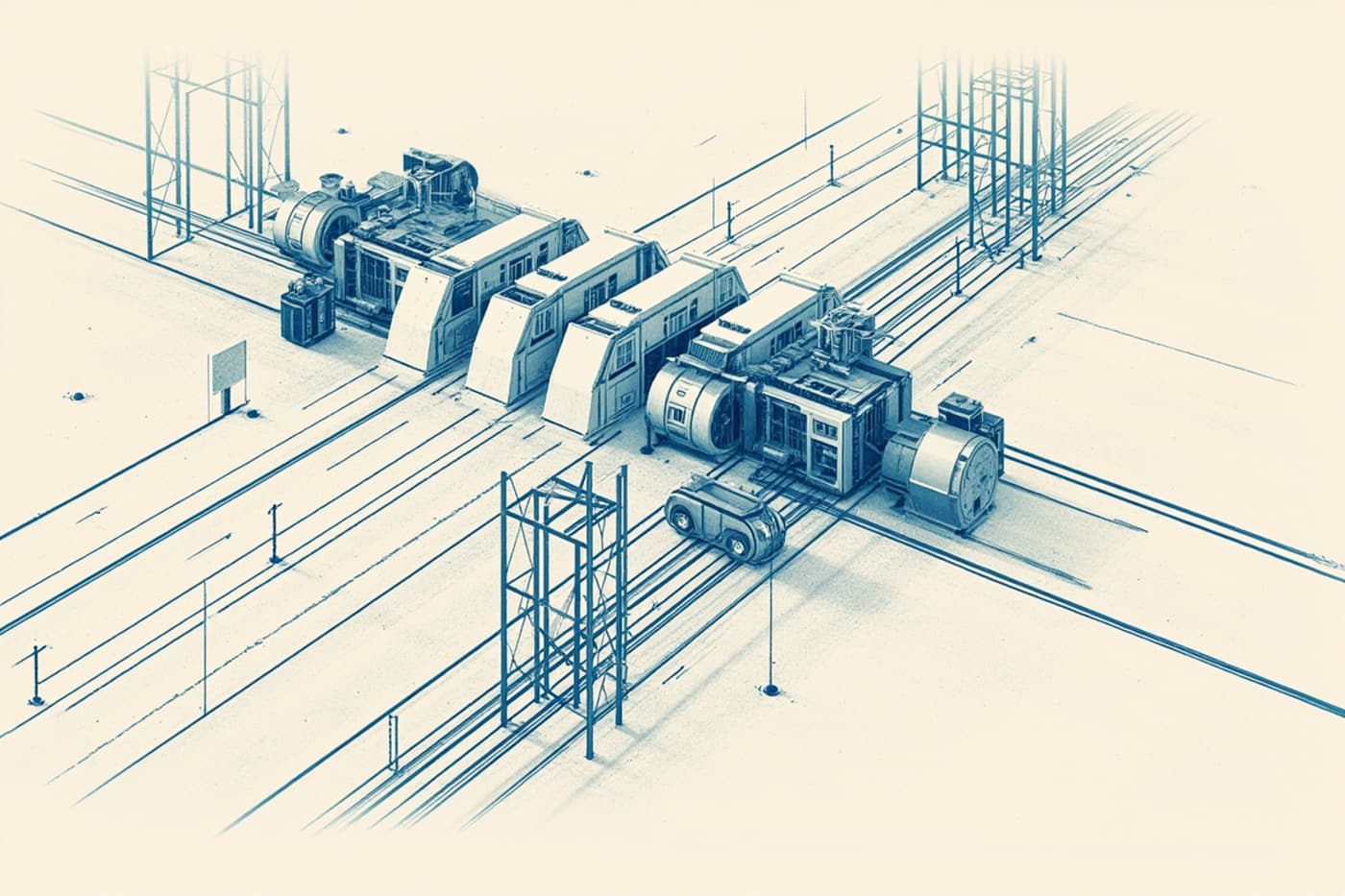

The partnership architecture reinforces the flywheel. A master CRADA with NREL, which spans four of the five priority targets, would provide certified testing infrastructure and a single point of access to DOE funding networks. Tier-1 experimental collaborators — the Manthiram Laboratory and TexPower for cobalt-free cathodes, the Ceder group at UC Berkeley and LBNL for halide electrolytes, the University of Münster for Li-metal interface analytics, DTU’s Chorkendorff group for ammonia verification, and the Yaghi and Long groups at UC Berkeley for MOF direct air capture — supply the synthesis and characterization data that close the loop. Each validated measurement makes the next prediction more trustworthy.
The economic case
The macroeconomic argument is not speculative. The NIST Materials Genome Initiative economic analysis estimates that improved materials innovation infrastructure would deliver $123 billion–$270 billion in annual value to U.S. industry[7]. ARPA-E’s portfolio has catalyzed billions of dollars in private follow-on funding and substantial IPO or acquisition value[8]. Self-driving laboratories funded by ARPA-E and CHIPS Act investments could compress materials-development timelines from 10–20 years to 2–5 years.
Against that backdrop, the cumulative 36-month budget is approximately $3.2 million. The leverage ratio justifies the expenditure even if only one of the five priority targets — cobalt-free cathodes, halide solid electrolytes, MOF sorbents, electrochemical ammonia catalysts, or lead-free perovskites — yields a commercially viable material. Each target addresses a large and growing clean-energy market, and the combined climate impact potential is substantial.

The investment thesis is therefore not a bet on a single material. It is a bet on the infrastructure that makes every material-discovery program more capital-efficient. Corrected screening campaigns become economically possible where brute-force DFT is not. Verified predictions reduce the false-positive tax that currently consumes lab time. Partners across the stack — generators, databases, autonomous labs, OEMs, national labs — capture more value from their own data because the trust layer exists.
Risk and honesty
A proof-first voice requires naming what is still open. The fcc error field is established; extension to bcc, hcp, and layered structures is the critical path item in Phase 0, with a go/no-go gate at Month 3. A second-shell correction may be needed for systems where first-shell coordination alone does not resolve the error geometry. Industrial validation partners are targeted but not yet contracted; until synthesis data arrive, the transfer claims remain computational.
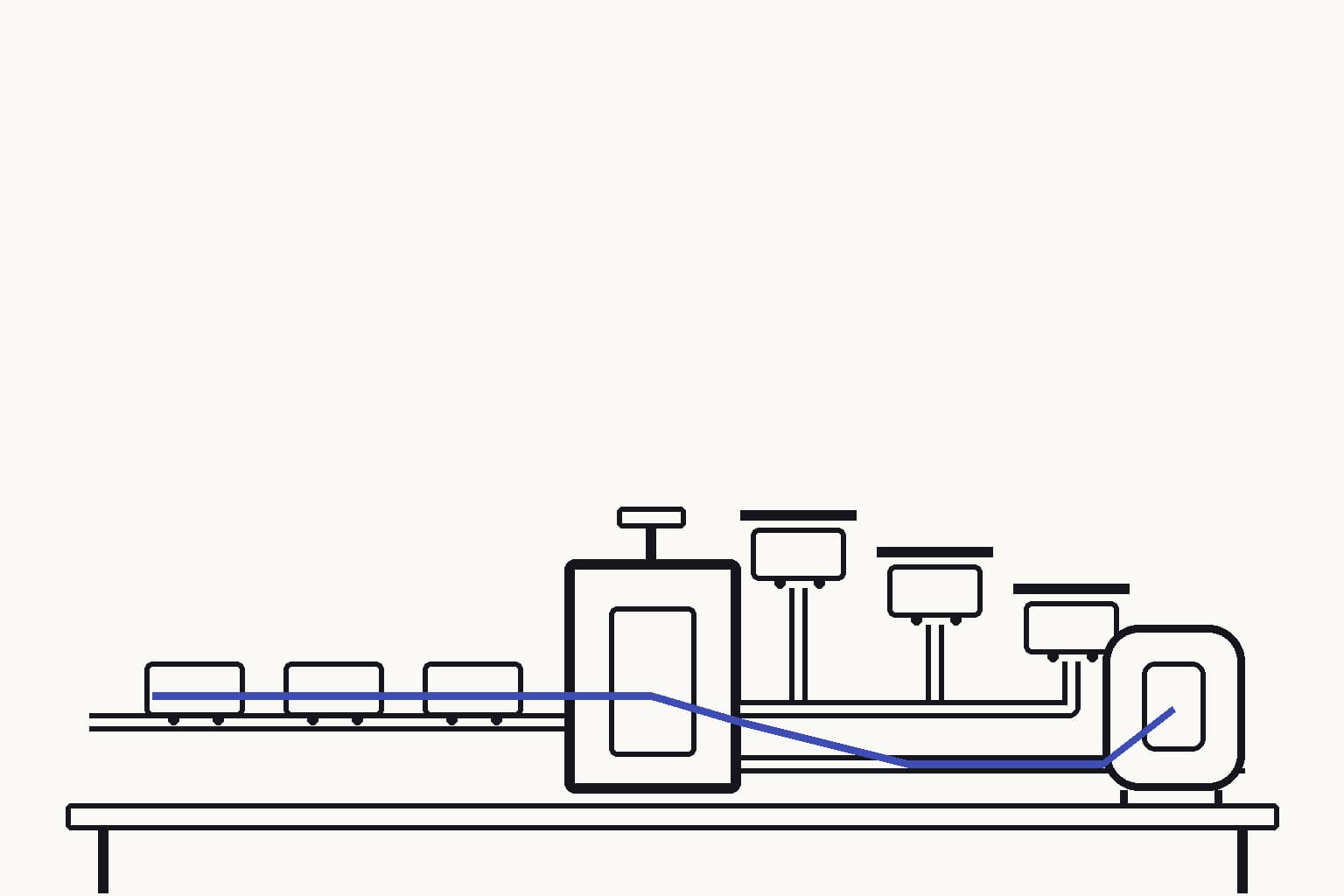

These are engineering risks, not conceptual ones. The conceptual question — whether uMLIP errors are structured and measurable — has been answered affirmatively for fcc metals. The remaining work is to extend the field’s jurisdiction and to prove, with each new structure family, where correction applies and where it does not.
The trust layer for a real-world Replicator
The long-term vision is a discovery pipeline in which AI-designed matter can be made, measured, and believed. Structure generators propose; the trust layer corrects and verifies; experimental partners synthesize; the result feeds back into the field database and the theorem library. The loop accelerates not because errors are hidden but because they are characterized.

The climate window is unforgiving. A material discovered in 2035 may miss the 2040 deployment window, and the cumulative emissions difference between deployment in 2035 versus 2045 is measured in tens of gigatonnes. The world does not need more predicted crystals. It needs a smaller, defensible set of predictions that laboratories can act on.

That is the trust layer. It is the infrastructure that converts the abundance of generated materials into the scarcity of validated ones — and it is the investment that makes the rest of the climate-materials pipeline economically rational.
For climate investors: the full slide presentation, The Trust Layer for Climate-Critical Materials, walks through the capital ramp, the five targets, the moat, and the ask.
Open the presentation →Footnotes
A. Merchant et al., “Scaling deep learning for materials discovery,” Nature 624, 80–85 (2023). https://doi.org/10.1038/s41586-023-06735-9 ↩︎ ↩︎ ↩︎
N. J. Szymanski et al., “An autonomous laboratory for the accelerated synthesis of novel materials,” Nature 624, 86–91 (2023); J. Leeman et al., “Challenges in High-Throughput Inorganic Materials Prediction and Autonomous Synthesis,” PRX Energy 3, 011002 (2024). https://doi.org/10.1038/s41586-023-06734-7; https://doi.org/10.1103/PRXEnergy.3.011002 ↩︎
International Energy Agency, Global EV Outlook 2024, IEA, 2024; IEA, Energy Technology Perspectives 2023, IEA, 2023. ↩︎
C. Zeni et al., “A generative model for inorganic materials design,” Nature 633, 812–818 (2024). https://doi.org/10.1038/s41586-024-07816-6 ↩︎
Y. Deng et al., “Benchmarking machine learning potentials for the discovery of new materials,” Nature Communications 15, 1673 (2024). https://doi.org/10.1038/s41467-024-45870-1 ↩︎
L. Hu et al., “Machine learning Δ-ML potentials for materials: Progress, challenges, and outlook,” Current Opinion in Solid State and Materials Science 26, 100996 (2022). https://doi.org/10.1016/j.cossms.2022.100996 ↩︎
NIST / RTI International, Economic Analysis of the Materials Genome Initiative, National Institute of Standards and Technology, 2023. ↩︎
ARPA-E, “ARPA-E Impact,” U.S. Department of Energy, 2023. ↩︎