
AI is designing the matter the energy transition runs on. Every prediction rests on interatomic potentials that are wrong in structured ways. Lupine measures, proves, and corrects that wrongness — so climate capital funds validated materials, not guesses.
The IEA projects clean-energy investment must grow from $1.8 trillion in 2023 to $4.5 trillion a year by the early 2030s. Batteries are directly linked to ~20% of required 2030 CO₂ reductions and indirectly to another 40%. The binding constraint is no longer generating candidates; it is knowing which predicted materials can actually be made, at cost, inside the 2025–2035 deployment window.
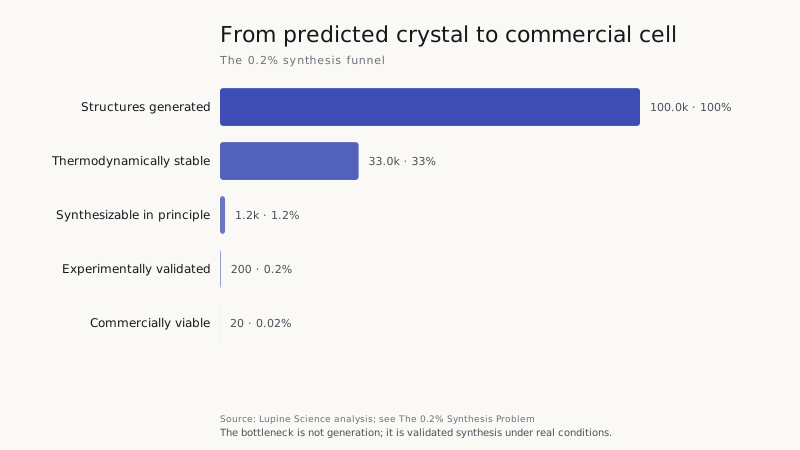
GNoME predicted 2.2 million crystals; 380,000 were computed stable; only 736 had been independently synthesized by late 2023 — a 0.2% validation rate. A-Lab's Author Correction records 36 confirmed of 57 eligible targets, 4 inconclusive, and one compound removed; independent review separately found many “novel” targets were already-known disordered phases. Faster synthesis without better verification does not close the gap.
We are not short of predictions. We are short of validated predictions. Every false positive burns synthesis budget and calendar time the climate window does not have.
Across 15 elements and hundreds of potentials, prediction errors concentrate on a low-dimensional surface. Classical and foundation MLIPs fail in the same direction. That is the investment thesis: if every model is wrong the same way, one correction layer transfers across the entire stack.
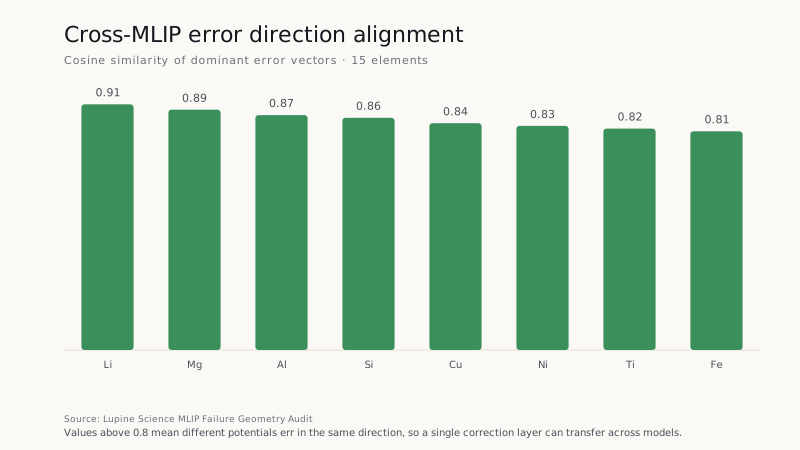
Three anchor observables fix an error field over local atomic environments. Blind prediction achieves Pearson r = 0.906 (p = 10⁻⁴, 95% CI [0.82, 0.96]) across 36 (model, material) combinations.
An analytic overlay applies the correction inside LAMMPS with any uMLIP — CHGNet, MACE, Orb, and what comes next. 15.6% overhead today, <1% compiled, still ~10⁵× faster than DFT.
The machine-generated Lean 4 theorem inventory, with zero sorry proofs, states what is supported. Where correction cannot apply, the system proves impossibility or bounded uncertainty instead of reporting a p-value.
Every corrected claim now ships as an executable certificate. The universal correction spine formalizes scope, residual bounds, numeric and runtime contracts, trajectory validation, and scientific attestation in Lean 4 — and mirrors the same fail-closed gates in Rust with CLI validators. Discovery gates and licenses turn correction coverage into a diligence artifact across candidate panels for cathodes, halide electrolytes, MOFs, and perovskites.
| Target | Climate impact | Market context | Key barrier | Lupine mechanism |
|---|---|---|---|---|
| Cobalt-free LMR cathodes | 2–5 GtCO₂ | $400B+ Li-ion chain | Voltage fade; TM migration | Corrected migration barriers preserve mobility ranking |
| Halide solid electrolytes | 1–3 GtCO₂ | $886M → $24.3B by 2034 | Li⁺ barriers underestimated 60%+ | Corrected barriers recover DFT accuracy at screen scale |
| MOFs for direct air capture | 0.5–2 GtCO₂/yr | $4.3B DAC market by 2034 | Humidity stability; cost >$50/kg | Corrected hydrolysis barriers; impossibility proofs |
| Electrochemical ammonia | ~0.45 GtCO₂/yr | $221.6B green NH₃ by 2035 | N≡N activation; HER competition | Corrected N₂ dissociation; flags scaling-relation breakers |
| Lead-free perovskites | 0.5–1 GtCO₂/yr | $11B PV market by 2033 | Sn²⁺ oxidation; metastability | Corrected vacancy formation energies; provable boundaries |
Simulation-trust software and calibration services for labs, AI-for-science teams, and industrial R&D — a revenue base that pays for the manifold to expand.
Materials-IP discovery and licensing driven by the corrected signal across the five climate targets — the asymmetric upside investors are actually underwriting.
LUPI, the browser-native WebGPU viewer, makes every claim inspectable. Partners and auditors can open the same atoms, fields, and certificates we do.
Three pillars make the position defensible. The error field is measured, not learned — fixed by observables and transferable without per-system retraining. The claims are machine-checked, so they cannot be hand-waved around. The runtime is compatible with every major uMLIP, so the layer rides the whole field’s progress. Every screening campaign adds validated field measurements; every impossibility proof sharpens the boundary of applicability; every theorem widens the verified domain.
NIST’s Materials Genome Initiative economic analysis estimates $123B–$270B in annual value from improved materials innovation infrastructure. ARPA-E’s $3.5B portfolio catalyzed $11.8B in private follow-on funding. Lupine sits between generation and synthesis — the point where speed without accuracy turns into wasted experiments, and where a trusted correction converts directly into saved lab budget and faster deployment.
NREL spans four of five targets and is the highest-value master-CRADA candidate. Argonne and PNNL’s Battery500 anchor cell-level validation.
UC Berkeley (Ceder, Yaghi, Long), UT Austin (Manthiram), DTU (Chorkendorff), and Stanford (SUNCAT) provide the experimental credibility layer.
GM/Ultium, POSCO Future M, BASF, Solid Power, and Climeworks pull validated materials into cells, sorbents, and deployed systems.
Deliver Lupine’s correction and verification layer to all major supercompute sites and university + industry labs within 12 months; build the founding team; expand the manifold across bcc, hcp, and layered structures.
founder@lupinesci.com · lupine.science · lupi.live