Research note
The Union Verdict: A De-brief on the Z1 Campaign
The full account you asked for before we talk — the verdict, the economics, the failures, the catches, and where I'd push back

You asked for the complete picture before our conversation, so here it is as I'd give it across the desk: what we set out to prove, what the campaign actually said, what it cost, what broke, and the places I'd push back before anyone quotes these numbers. The receipts for every claim are one click away in the Library, and the monitoring bug and two of the review catches below are mine — I've marked them.
What we set out to prove
The thesis under test: a universal MLIP can guide DFT to a handful of anchor points near a predicted transition state, and a sparse barrier assembled from those anchors recovers the dense-DFT barrier — and further, that several architecturally different models can share those anchors, because the anchors are model-independent evaluations and only the guidance differs. If both hold, barrier chemistry stops being a per-model expense and becomes shared infrastructure: every additional model’s guidance validated at near-zero marginal cost.
The verdict
All four models scored STRONG_WIN — same-engine sparse-barrier MAE within the ≤15 meV gate (WIN gate is 40):
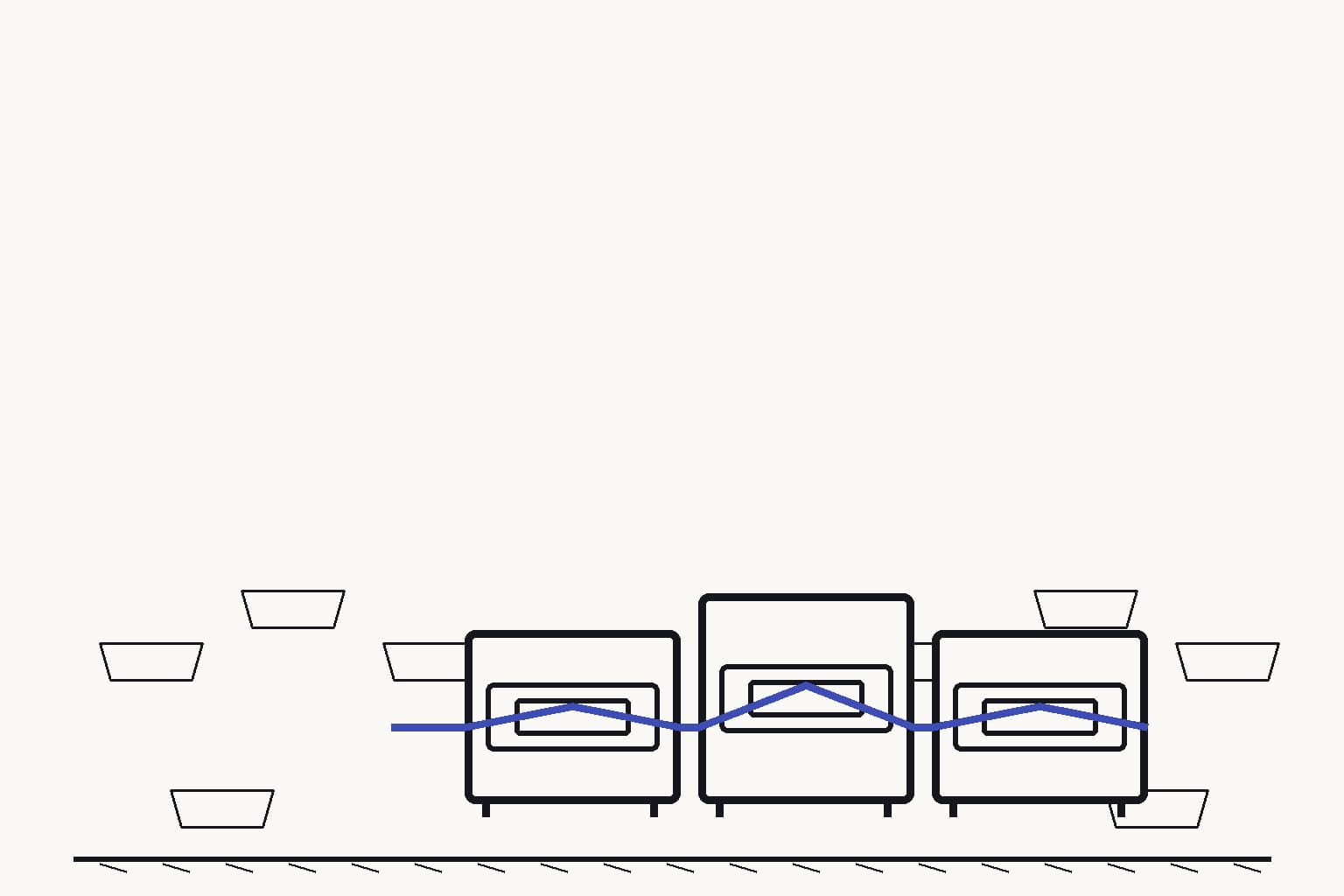
- chgnet: 0.0 meV over 22 guided paths
- mace-mp-medium: 0.0 meV over 22
- mace-mp-small: 6.8 meV over 21
- mace-mpa-0-medium: 6.8 meV over 21
129 of 129 anchors evaluated, zero failures, zero memory skips. Full table and per-path breakdown in the verdict of record.
Two honest notes before the headline goes further. First, the split inside that win is the real result: chgnet and mace-mp-medium located the true extrema on every guided path — their sparse barriers are exactly the dense barriers, and our union law theorem explains why that must be so. mace-mp-small and mace-mpa-0 missed the true saddle on some paths, and their 6.8 meV deficit is pure undercoverage error. The protocol now ranks model guidance for free — a capability we did not have last week. Second, the gate’s teeth are thin on short paths: with 5–7 images, our dense extension makes “sparse” nearly equal “dense” by construction, so part of the verdict is structural. What is not structural: the guidance split, the economics, and the cost. The true stress test of sparsity is a longer-path panel — that is question one for us.
The economics, measured
- Naive per-model execution: 430 anchors. Union executed: 129. That is 70% fewer DFT evaluations (3.33×) — the prediction said 72.4%, and we landed inside it.
- 129 anchors, 61.0 wall-hours, $14.65 cloud-equivalent — the full measured ledger is in the cost record. Local electricity: sixty cents.
- The scaling law held: four models of guidance cost ~10% more DFT than one. Cross-model validation is nearly free at the oracle.
- The best illustration: path-16 consumed 62 CPU-hours at the old frozen settings and never produced a receipt. At the adopted settings it ran at about five minutes an anchor.
The journey, honestly
This did not go straight. Path-7 failed at 118.8 meV and the failure turned out to be the most valuable datapoint of the campaign: the GPAW↔VASP offset isn’t constant, it wanders — 139 meV on path-7, up to 4.2 eV on path-0 — and barriers difference energies, so wander lands on the verdict. That became amendment 01 (same-engine basis), the T1 wander gate, and eventually a machine-checked theorem: barrier error is bounded by offset wander, never by the offset’s size. The measured MAE (693–706 meV) sits under the mean wander (952 meV), as the law requires.
Path-16’s 62 CPU-hours forced your call: frozen runs are investment-grade. The escape was a 12-anchor revalidation — Gamma k-points and a looser grid, each gated against a pre-agreed 5 meV criterion. Both passed, and the combined profile passed (−4.36 meV) after a code-review bot caught my invalid adoption of the untested combination 40 minutes after I wrote it. The fix cost 18 minutes of compute.
The wander itself then got a mechanism: the extreme cases are metallic transition states (0.018 eV gap at path-0’s saddle) where the two engines converge to different electronic descriptions on exactly that image. And when GPAW warned that a 34.4° skewed cell might corrupt its own results, we audited instead of hoping: barrier shifted 3.5 meV, valid. That is the third instance of the pattern this campaign produced — convention offsets, settings offsets, cell offsets: barriers cancel constants; only wander matters.
What this does not prove
I’d want these five caveats attached to any external use:
- Short-path structure: on ≤7-image paths the sparse protocol is nearly dense by design. The accuracy-of-sparsity claim is untested at length.
- The VASP-referenced basis is contaminated across 22 of 23 paths (mean wander 952 meV). We measured it, bounded it, and explained the extreme cases — but a GPAW↔VASP equivalence claim is not ours to make yet.
- One panel, one chemistry family (Li-migration LiTraj), one engine, one functional.
- Seven ≥159-atom paths remain deferred; their verdicts are pending, not absent.
- Two models showed guidance misses; where and why is uncharacterized.
What outlasts the campaign
The BarrierTransfer theorem family is machine-checked in Lean 4: the T1 wander law, the same-extrema identity, the sparse-anchor law (sparse ≤ dense), the union law (extrema-covered sample sets are exactly dense), the kinetic corollary (rates bounded by exp(wander/kT)), and the coverage bound (deficit ≤ 2·L·d). The pilot’s protocol now has a proved skeleton. The mechanism note is filed here — with the candidate next theorem, a saddle-metallicity gate, inside.

The questions for our conversation
- Commission a longer-path panel (the real sparsity test), or first re-attack the deferred big-7 at adopted settings (now plausibly ~2–4 h/path locally)?
- Engine-equivalence repair (smearing/occupation policy at metallic saddles) to reclaim the VASP basis — or declare same-engine permanent and re-baseline panels to GPAW-computed references?
- Characterize the mace-small / mace-mpa-0 guidance misses (which chemistries) before anyone quotes 6.8 meV.
- Wavefunction reuse between neighboring anchors — an unclaimed 20–33% lever the literature review surfaced; implement before the next campaign?
- Z2: the Tiwari fix failed review twice — small physics fix; do I take it directly, or leave it with the team?
Resources
- Verdict of record — per-model and per-path tables
- Measured cost ledger — $14.65, per-path wall-hours
- Union-anchor economics — the 558/154 record and scaling curve
- T1 wander mechanism — metallic saddles, SCF fragility
- Niggli audit — the skewed-cell validity check
- Campaign machine record:
data/candidates/z1-union-campaign.json(sha256-pinned) in the open repository
This is a de-brief draft for the lead’s review ahead of our conversation. Numbers are of record; framing is mine to defend.