Research note
The Trust Layer
The founding thesis of Lupine Science — verification as the missing infrastructure of AI-driven discovery

The oldest loop in the world
Science works one way. Conjecture how the world might be, test the conjecture against reality, keep what survives. Every material fact you rely on came through that loop: the steel in a bridge, the silicon in this screen.
For four hundred years the loop had one speed limit. Reality is slow to consult. Experiments take months, synthesis takes years, and careers are spent confirming a handful of conjectures.
In the last few years, two-thirds of the loop went to software speed.
What just happened
Generative models learned to propose matter. Not vaguely. They write down specific arrangements of specific atoms, in crystallographic detail, faster than any lab can evaluate them. Imagination stopped being the bottleneck.
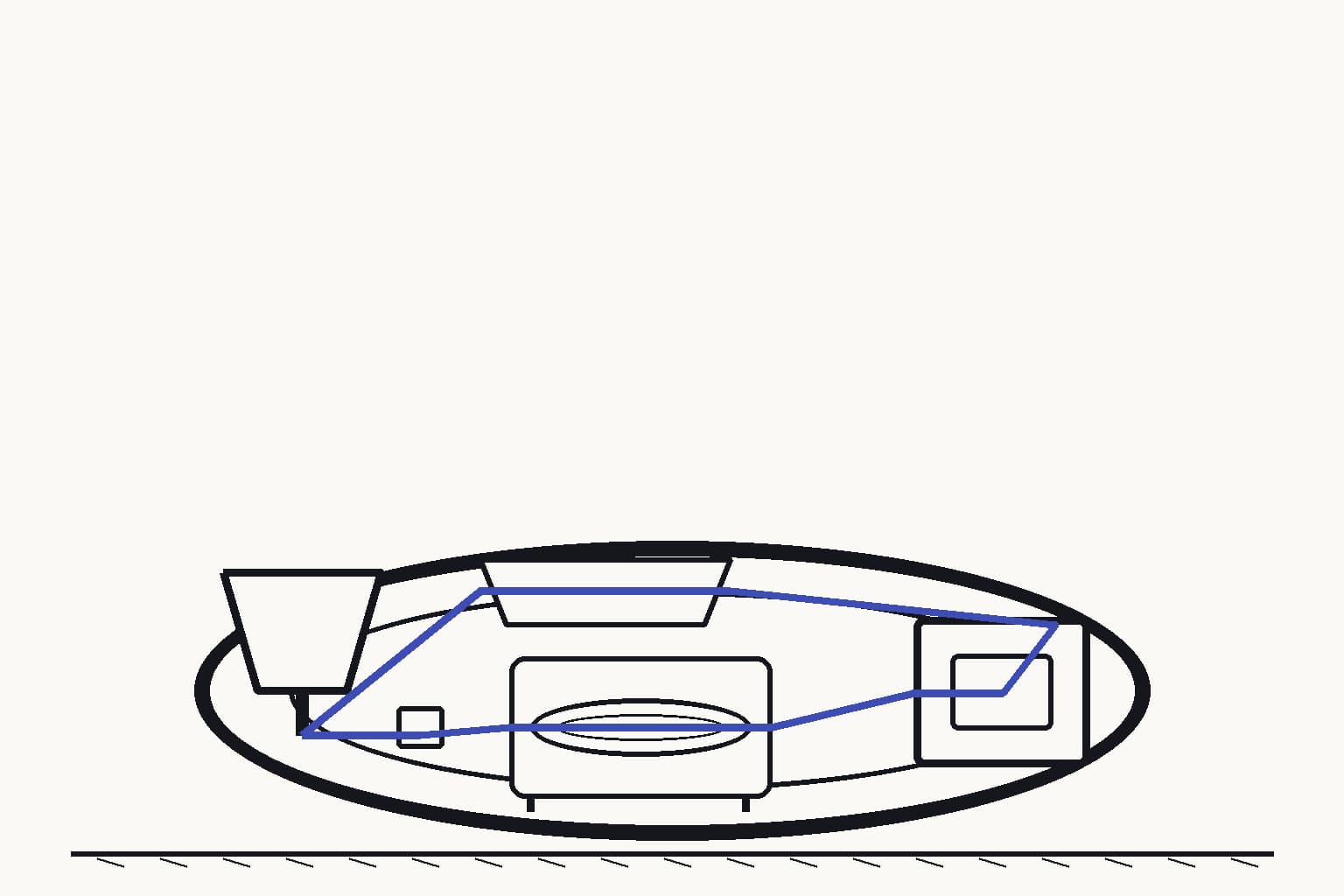
Machine-learned simulators learned to stand in for physics. Screening that once queued for supercomputer time now runs at software speed, close enough to the underlying quantum mechanics to be useful. The first, cheap kind of testing stopped being the bottleneck.
Belief did not get faster.
A model can be confident and wrong. A confident prediction that later fails in synthesis is the normal case. The number that matters is not raw output; it is how many proposals are worth a year of lab time.
That question now gates the entire pipeline. Millions of candidates, software-speed screening, and then a queue of people deciding what to attempt, armed mostly with intuition about when their tools are wrong.
Belief is the bottleneck. That is the problem addressed here.
Trust as infrastructure
“Trustworthy AI” usually means disclaimers and good intentions. Here it means a mathematical characterization of how a class of predictions fails. It is proved, machine-checked end to end, and published with the data. Run it yourself.
This is the opposite of caution. The slow part of science is re-checking: every lab re-derives and re-benchmarks because nobody’s word can be relied on. A verified result is different. It is checked once, and everyone builds on it, the way engineers build on a proved theorem without re-proving it. Verification removes that cost for everyone downstream.
Evidence before claim
A company whose thesis is proof cannot ask to be taken on faith. Here is where the work stands, checkable today:
- The mathematics of the error-geometry result lives in a working paper. It is in preparation and not yet peer-reviewed. Its core has been formalized and machine-checked in Lean, with the record in the open repository.
- The benchmark behind the claims is committed, public data. The front page does not quote the numbers. It recomputes them, live, in the browser, from the same files used in the work.
- The crystal drawn there is not an illustration. It is real, published crystallography, rendered from a committed structure file anyone can open.
- When an internal idea has failed, the failure stays in the record.
None of this is a breakthrough announcement. The claims are modest because the standard is the product. Everything above is checkable today.
Why in the open
This could have been built as a black box: a proprietary trust score, a private benchmark, an API that says “believe this one.” It would have been easier to sell and impossible to believe. A trust layer you cannot check is just another confident model.
So the evidence ledger, the proofs, and the benchmark data are public, and the site computes them in front of you. Open results are worth more, because other people can build on them without asking permission.
The closed labs of this era are betting that intelligence is the scarce asset. The bet here is on verified knowledge. The binding constraint on this field is how much of the models’ output the world can act on.
Place in the ecosystem
This is not another generative model, and it is not a robot lab. It sits between them.
Model builders get what they cannot grant themselves: external verification of their predictions. Laboratories get shortlists whose failure modes were characterized before synthesis starts. Formalizers get proofs that gate real decisions instead of sitting in journals.
Everyone in that loop moves faster because the trust between them is load-bearing. That is the company: the trust layer between the models and the bench.
The invitation
The materials that define the next century exist today only on paper. Specific arrangements of atoms nobody has made, waiting on one question: is the result believable enough to try?
The machinery that answers with proof is being built in public, so the answer never has to be produced twice.
If you have synthesis data, build models, or invest in this field: the record is open, and getting in touch is straightforward.
Visit lupine.science. Check the record. That is the point.