Research note
The Savings Stack: A Booklet on Doing Less, and the Commons That Makes Everyone Faster
Seven savings layers from the literature, one measured sharing economy, and the theorem commons — as a free, designed booklet with a hashable data pack

Today we are releasing The Savings Stack — a sixteen-page booklet on how atomistic simulation learned to do less, what that savings stack is still missing, and the measured economics of sharing the expensive part. It is a free download, built to be read: the literature digests, the union-anchor measurement, and the citation audit are all in the pack behind it, hashed and reproducible.
Download: The Savings Stack — 16 pages, US Letter, free.
Get the booklet (PDF, 748 KB) →Inside the booklet
The booklet is the designed edition of the Savings Stack v1 release: typography-led, one idea per page, every number anchored to the committed record.
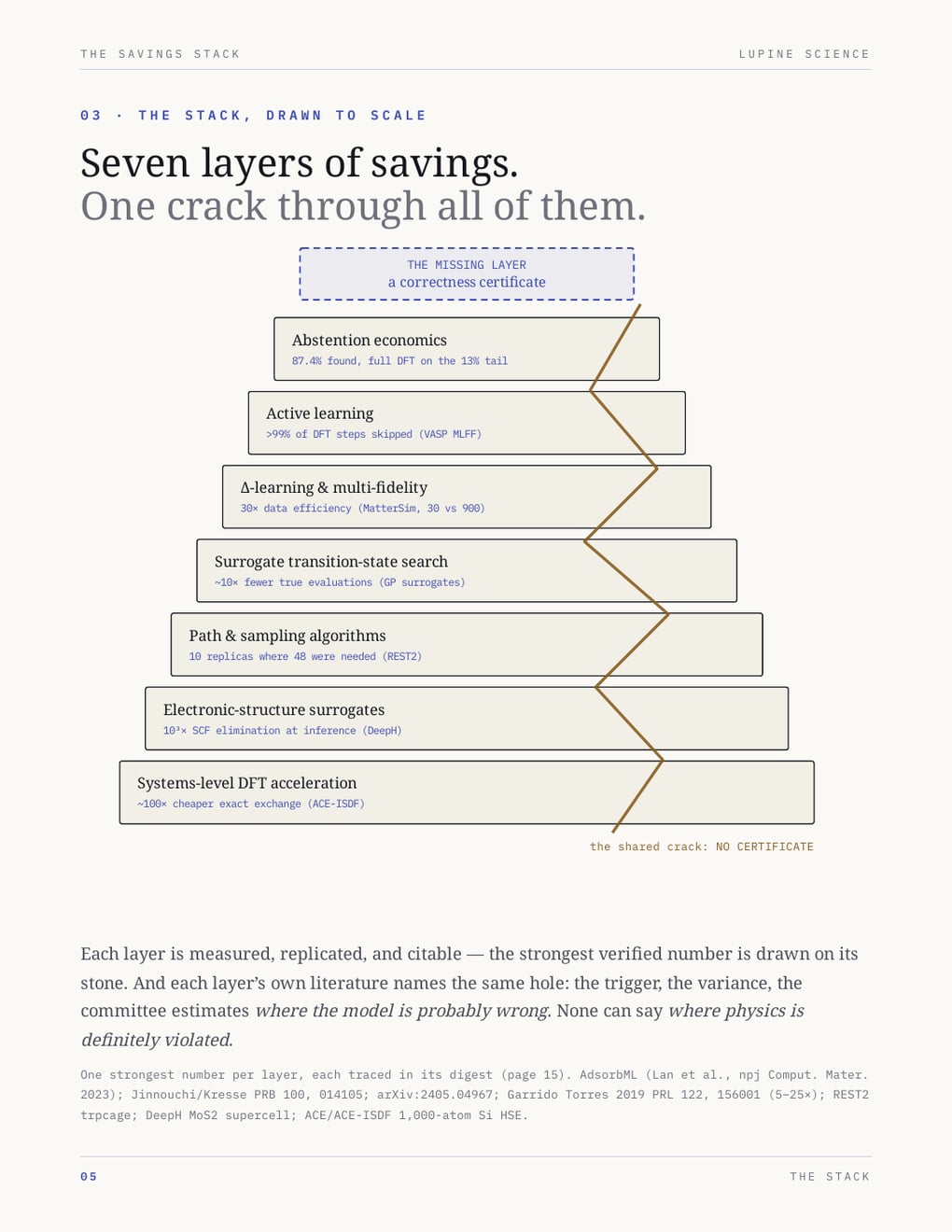
Seven chapters of the underlying book survey the savings layers the field invented independently — surrogate transition-state search, active learning, Δ-learning, abstention economics, systems-level DFT acceleration, electronic-structure surrogates, and path and sampling algorithms — each with its strongest verified number and its named hole. Two backdrop chapters cover four decades of supercomputing economics and today’s compute-resourcing landscape. The hole is the same shape in every layer: plenty of signals for where the model is probably wrong, no certificate for where physics is definitely violated.
The measured core, in one paragraph
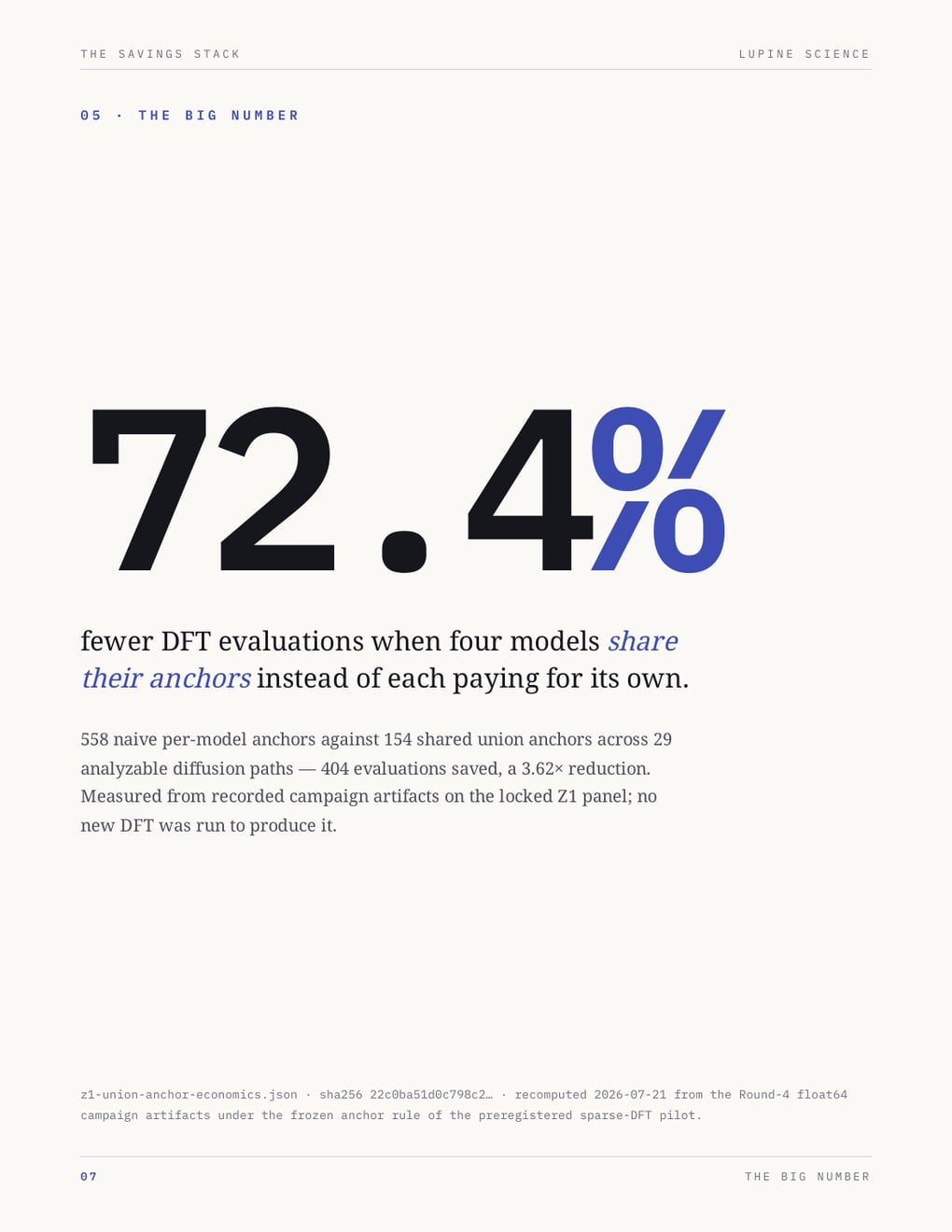
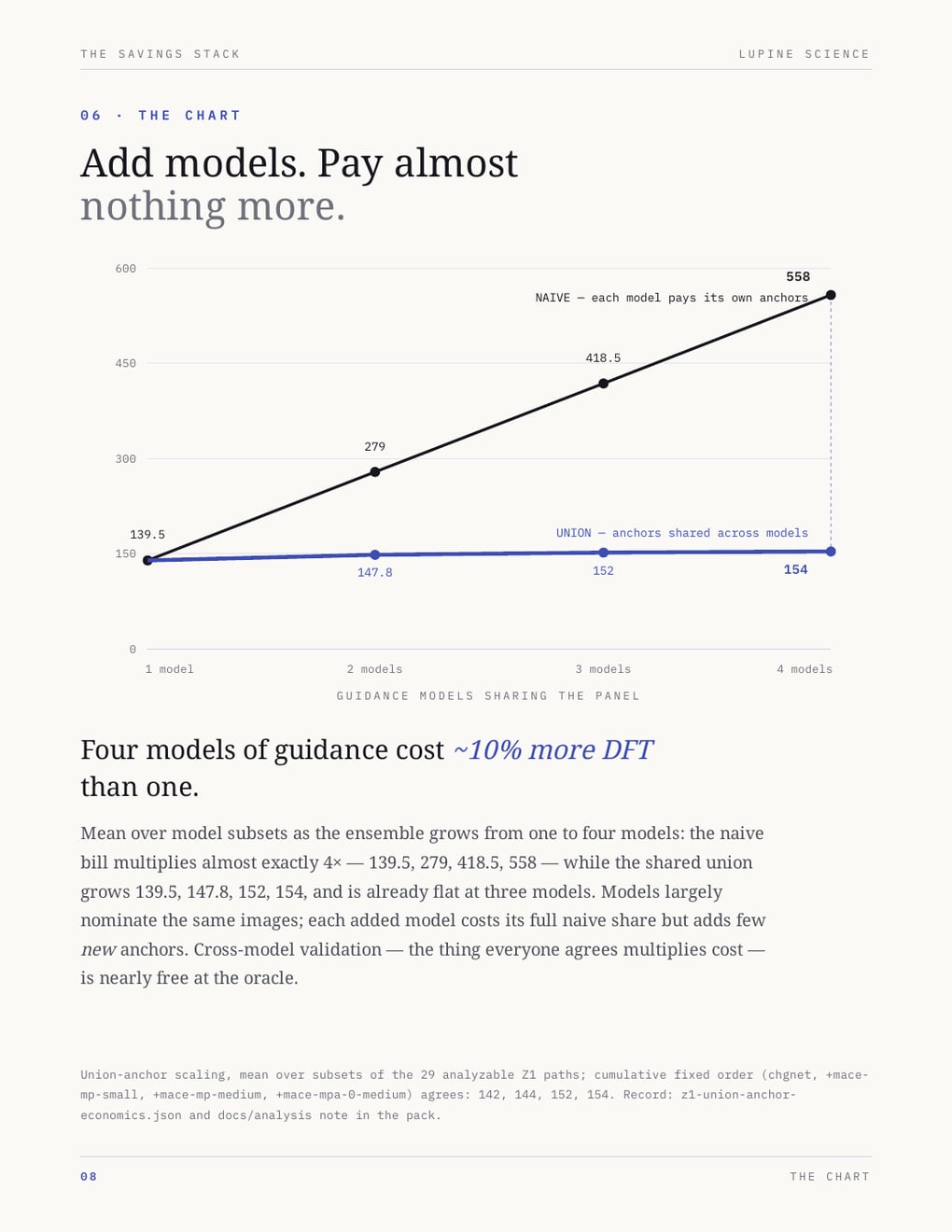
On the locked 30-path Z1 panel, path 14 failed CI-NEB convergence in all four model artifacts — the honest denominator is 29. Across those 29 analyzable diffusion paths, the frozen sparse-anchor protocol would consume 558 naive per-model DFT anchors; shared across the four models, the union is 154 — 72.4% fewer evaluations, a 3.62× reduction. The scaling law is the headline: as guidance models go from one to four, the naive bill multiplies ~4× (139.5, 279, 418.5, 558) while the union stays nearly flat (139.5, 147.8, 152, 154) — four models of guidance cost ~10% more DFT than one. The numbers were recomputed from recorded campaign artifacts under the frozen anchor rule; an earlier informal figure was retracted as arithmetic drift, and the analysis note in the pack reconciles it line by line. No new DFT was run to produce any of it.

What it is — and what it is not
The booklet makes the case for a theorem commons: teams contributing formally verified physical-law theorems back, so everyone’s gates get sharper. Theorems are non-rival and leak nothing about the contributor’s chemistry; the measured union economics are the evaluation-side instance of the same sharing. The case for restraint is designed with equal care: the measured basis is one 30-path panel, four universal MLIPs, one DFT engine, one chemistry family; the multiplicative stacking figure is a derived estimate and is labeled as such wherever it appears; the digests keep their [UNVERIFIED] flags; and none of this is peer-reviewed — it is a research release with committed, hashable records.
The citation audit behind the book verified every identifier against its registry: 115/115 arXiv, 48/48 DOI, zero unresolved — with three corrections applied on the record, including the VASP MLFF venue reconciliation. Identifier verification does not upgrade abstract-only evidence, and the booklet says so.
Data and reproduction
The booklet is the cover story; the pack is the evidence. The v1 pack ships all ten chapters, the machine-readable union-anchor record (JSON + sha256 sidecar), the analysis note and script, the citation audit, and a MANIFEST.sha256 over every file. Structured data is released under the Open Data Commons Open Database License 1.0 (ODbL-1.0), mirroring the source repository’s data license; prose and code keep their repository licenses.
sha256sum -c MANIFEST.sha256 verifies the pack; python3 union_anchor_economics.py --local <artifacts> --out z1-union-anchor-economics.json recomputes the record.
Receipts
- The booklet: the-savings-stack.pdf (16 pages, Letter; source and build script in the repository)
- The data pack: /data/savings-stack-v1/ — ten chapters, record + sidecar, analysis note + script, audit, manifest
- Full scientific detail: library.lupine.science, group “savings-stack”
Next: read the booklet, hash the pack, recompute the record.
Download The Savings Stack →